Until the early 1990’s I practiced the eye-hand coordination required to draw and paint visually (paint what you see). Then I became intensely curious about how image was communicated through the marks I made. I began employing automated procedures and, eventually, electromechanical tools, many of my own design and construction. I continue to be fascinated by marks and mark-making, pattern, aesthetics, the past, and the location of meaning. My recent work is typically produced using traditional tools manipulated by non-traditional means. I’ve designed and built numerous computer-controlled jigs which hold pencils, pens, brushes, airbrushes, flow-pens, etc all moved and actuated via tens of millions of lines of instructions which are generated by computer programs I’ve written.
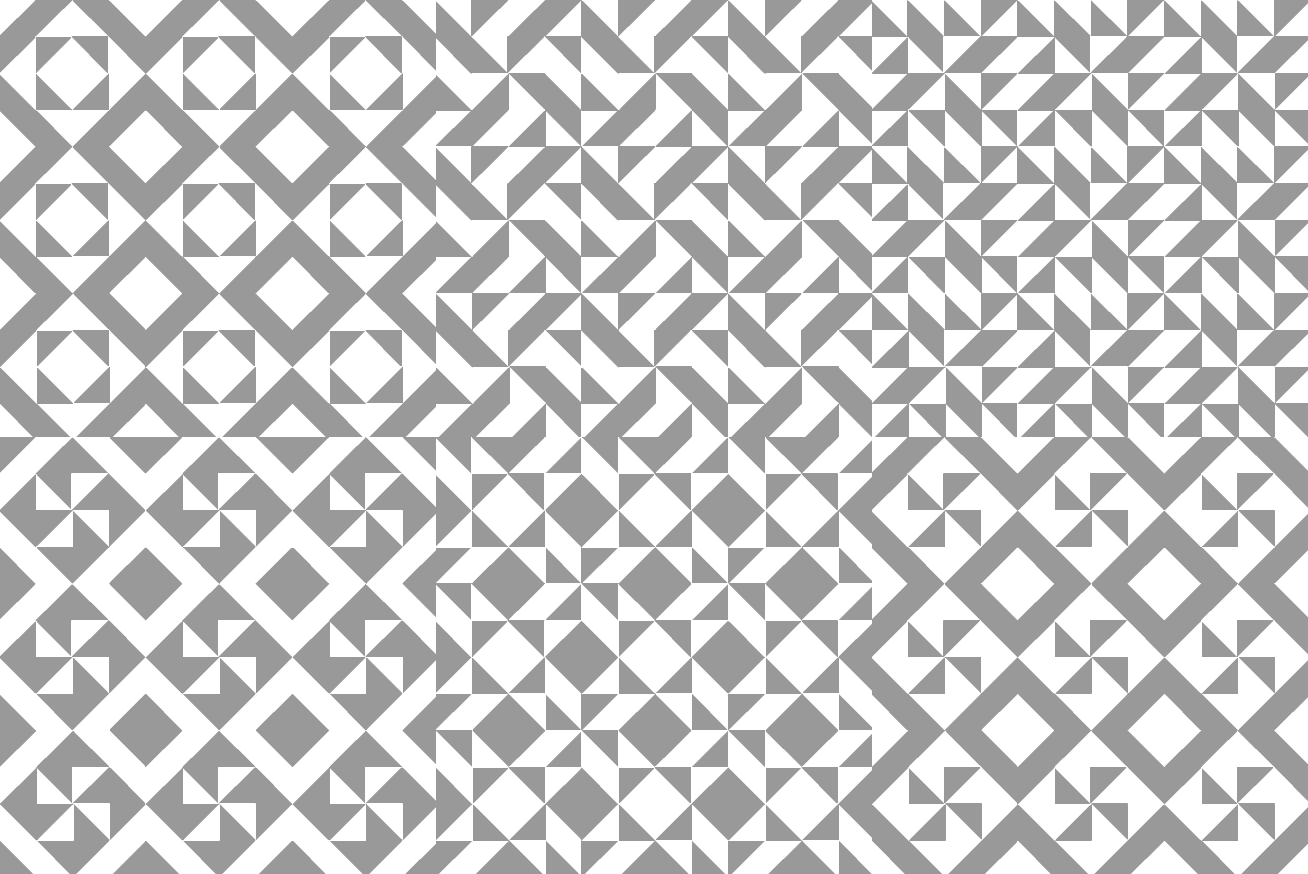
I began to seriously wonder about my aesthetic sense two decades ago while I experimented with patterns produced by ’tiling’. I was arranging painted tiles in grids using a computer model I invented. I produced hundreds of thousands of designs this way. For example, a minimal 4×4 grid of identical square tiles has more than four trillian (4^16) arrangements (way too many for me to evaluate)! To create a smaller universe, I limited my exploration to symmetrical arrangements. Some patterns were ‘vibrant’, some were ‘elegant’, some were ‘noisy’, some were ‘beautiful’, etc. It has been very difficult for me to understand why a strong connection exists between these congruent tile arrangements and my aesthetic response to each. I eventually realized that my preference developed unconsciously and likely had a genetic/neurological source. It seemed to me that I’d discovered a fundamental boundary between science (what I could understand) and art (what I could feel). This turns out to have deeply influenced all my subsequent work as I try to balance unconscious and conscious. These days, I am mostly making images of heads and figures. I like reflections between my work and art of previous generations. Most of my images parody 18th and 19th century Japanese subject matter (I’ve forever been fascinated by Zen and things Japanese). Lately I’ve become curious about post Renaissance European chalk and charcoal drawing technique, so I’ve been working with light and dark ink crosshatch methods. Now I experiment much more with squiggly cross-hatching than with tiling as I feel my way toward images which cry out to become Art. I’m no longer very concerned with eye-hand coordination. I’ve become deeply involved with what I make and how I make it.