2025 Statement
Mike Lyon (b. 1951) is a full-time artist in Kansas City, Missouri. Lyon received his BA from the University of Pennsylvania, his BFA from the Kansas City Art Institute, and studied moku-hanga (Japanese woodblock printmaking) under Hiroki Morinoue and Hidehiko Goto. He currently serves on the boards of the Anderson Ranch Arts Center in Snowmass, Colorado, the Tamarind Institute of Lithography in Albuquerque, New Mexico, and the International Mokuhanga Association in Tokyo, Japan.
Lyon is a pioneering figure in the field of post-digital printmaking. In his work as a printmaker, Lyon combines his knowledge of technology, cultivated during his 13 years as a computer hardware and software developer, with his formal art study. His invention of award-winning computerized order-filling systems for Tupperware and others is an integral part of his printmaking methods today. He has adapted the computer-controlled router to carve blocks, apply paint to canvas, and put pen to paper. Equally relevant in his work is Lyon’s childhood interest in Japanese art and culture, which is reflected in his collection of Japanese ukiyo-e prints.
- My work is a long series of experiments in ways to communicate image through an unusual kind of mark-making. My process is complex and analytical and involves programming computers and building machinery to manipulate traditional art-making tools, materials, and imagery using non-traditional methods. I’m looking to the old while inventing (sometimes re-inventing) the new. I typically portray the face, figure, or botanicals like grass or leaves. The creative work is almost entirely conceptual. Because every mark, line, or brush stroke is calculated in advance, I don’t get to see the results until the work is complete.
Lyon’s work and process are featured in Paul Catanese’s and Angela Geary’s Post-Digital Printmaking: CNC, Traditional and Hybrid Techniques (2012, Sylvie Covey’s Modern Printmaking: A Guide to Traditional and Digital Techniques (2016), April Vollmer’s Japanese Woodblock Print Workshop: A Modern Guide to the Ancient Art of Mokuhanga (2015), Barbara Thompson’s The International Block Print Renaissance: Then and Now (2021) and others.
His work is in the permanent collections of Bernard A. Zuckerman Museum of Art; Daum Museum of Contemporary Art; Kemper Museum of Contemporary Art; Miriana Kistler Beach Museum of Art; Nelson Atkins Museum of Art; New York Public Library; Spencer Museum of Art; Springfield Art Museum; University of Kentucky Art Museum; Wichita Art Museum;
2014 Statement:
Until the early 1990’s I practiced the eye-hand coordination required to draw and paint visually (paint what you see). Then I became intensely curious about how image was communicated through the marks I made. I began employing automated procedures and, eventually, electromechanical tools, many of my own design and construction. I continue to be fascinated by marks and mark-making, pattern, aesthetics, the past, and the location of meaning. My recent work is typically produced using traditional tools manipulated by non-traditional means. I’ve designed and built numerous computer-controlled jigs which hold pencils, pens, brushes, airbrushes, flow-pens, etc all moved and actuated via tens of millions of lines of instructions which are generated by computer programs I’ve written.
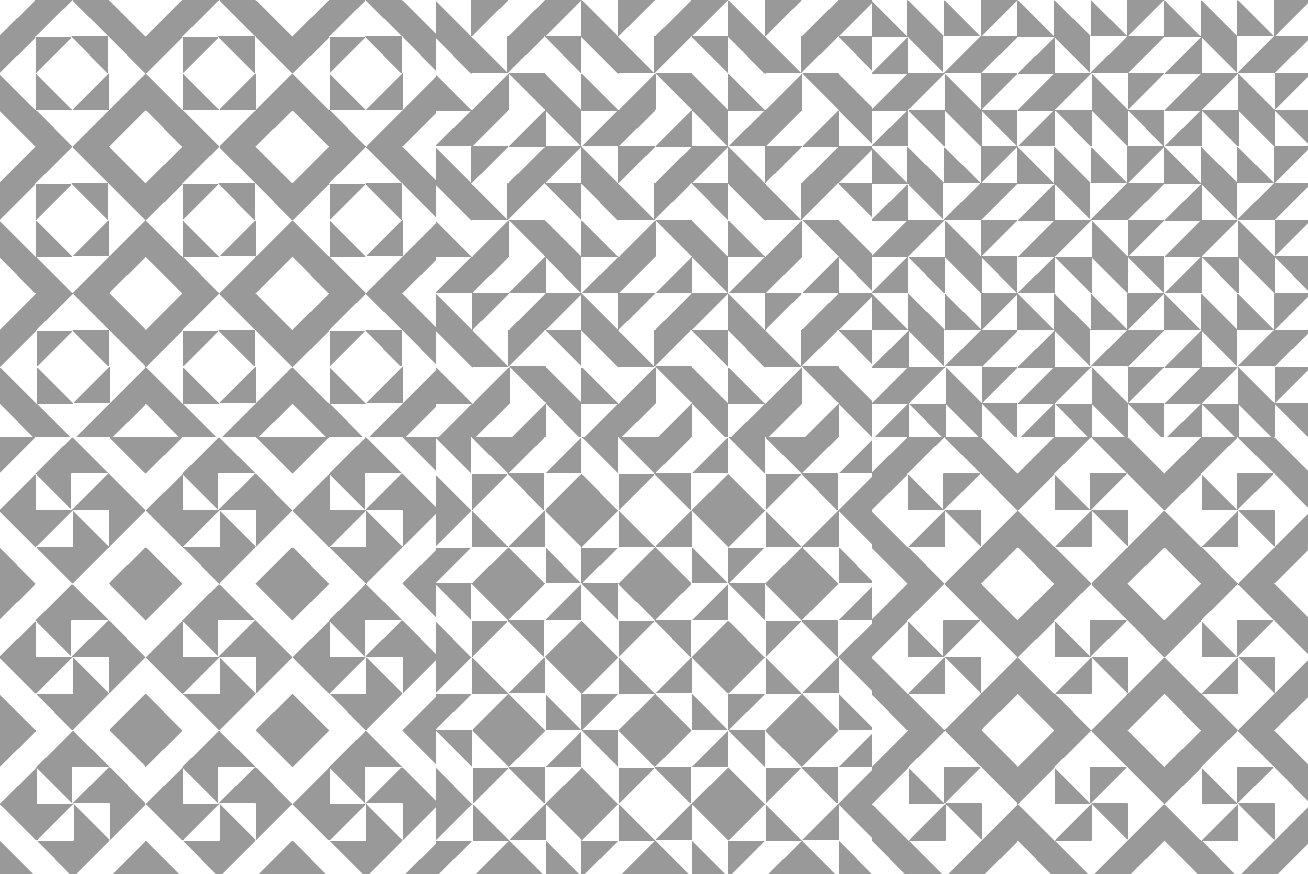
I began to seriously wonder about my aesthetic sense two decades ago while I experimented with patterns produced by ’tiling’. I was arranging painted tiles in grids using a computer model I invented. I produced hundreds of thousands of designs this way. For example, a minimal 4×4 grid of identical square tiles has more than four trillian (4^16) arrangements (way too many for me to evaluate)! To create a smaller universe, I limited my exploration to symmetrical arrangements. Some patterns were ‘vibrant’, some were ‘elegant’, some were ‘noisy’, some were ‘beautiful’, etc. It has been very difficult for me to understand why a strong connection exists between these congruent tile arrangements and my aesthetic response to each. I eventually realized that my preference developed unconsciously and likely had a genetic/neurological source. It seemed to me that I’d discovered a fundamental boundary between science (what I could understand) and art (what I could feel). This turns out to have deeply influenced all my subsequent work as I try to balance unconscious and conscious. These days, I am mostly making images of heads and figures. I like reflections between my work and art of previous generations. Most of my images parody 18th and 19th century Japanese subject matter (I’ve forever been fascinated by Zen and things Japanese). Lately I’ve become curious about post Renaissance European chalk and charcoal drawing technique, so I’ve been working with light and dark ink crosshatch methods. Now I experiment much more with squiggly cross-hatching than with tiling as I feel my way toward images which cry out to become Art. I’m no longer very concerned with eye-hand coordination. I’ve become deeply involved with what I make and how I make it.